Imported Food Warehousing in China: Compliance Essentials for Foreign Brands
For foreign food brands, clearing Chinese customs is only the beginning. What happens next — where the goods are stored and whether that storage is compliant — often decides a brand's fate in the Chinese market. China regulates food warehousing more strictly than most markets: warehouse licensing, Chinese labeling, temperature and humidity, shelf-life management, and traceability. A failure at any point can mean fines, corrective orders, destruction of entire shipments, or a brand being placed on regulatory watchlists.
1. International Client Scenario: Warehousing Is the First Gate for Imported Food
Foreign brands entering China typically pass through three warehousing stages:
- First arrival: goods land at ports such as Shanghai or Guangzhou and need temporary storage while awaiting customs inspection and quarantine release
- First distribution: after clearance, goods move into distribution warehouses serving wholesalers, retailers, and e-commerce platforms
- First compliance check: local market regulators inspect warehouse licenses, hygiene conditions, and inbound/outbound records
Key principle: in China, not just any warehouse can store food. Any facility holding imported food must hold a Food Business License whose scope includes "food warehousing," and must comply with the Food Safety Law and the Administrative Measures on Safety of Imported and Exported Food.
2. Regulations and Labeling Requirements for Imported Food
| Requirement | Details | |------|------| | Import qualifications | Overseas manufacturer registration; a domestic importer with food import business qualifications | | Chinese label | Every prepackaged unit must carry a Chinese label: product name, ingredient list, country of origin, production date, shelf life, importer name and address, nutrition facts | | Inspection & quarantine | Goods are released only after customs inspection; non-compliant lots may not enter the market | | Warehousing license | The warehouse must hold a Food Business License covering food warehousing |
Label non-compliance is the single largest cause of imported food rejections in China, accounting for over 60% of all cases. Foreign brands should finalize Chinese label artwork before shipping, then apply labels after clearance and before warehousing.
3. Warehouse Hardware and Hygiene Requirements
- Floor: epoxy coating, flat, non-absorbent, easy to clean; walls: smooth, mold-resistant wainscoting up to 1.5 meters
- Doors and windows: well sealed, with insect screens and rodent guards; doors self-closing
- Equipment: automatic temperature/humidity recorders, rodent and insect control devices, lidded trash bins
- Hygiene: daily cleaning, weekly deep cleaning, monthly professional pest control, hand-washing and disinfection before entering the storage area
4. Temperature and Humidity Management: The Lifeline of Food
| Food type | Temperature | Humidity | |---------|---------|---------| | Ambient food | 10-30°C | ≤65% | | Chilled food | 0-10°C | ≤75% | | Frozen food | ≤-18°C | - | | Temperature-sensitive (chocolate, etc.) | 15-22°C | ≤65% |
Management essentials: record temperature and humidity automatically every 30 minutes; trigger alarms when limits are exceeded (with mobile notifications); calibrate thermometers monthly; and maintain backup plans for refrigeration failure. Cases of a cold-room compressor failing overnight — silently ruining a warehouse full of goods — are unfortunately common.
5. Shelf-Life Management and Traceability
- Inbound inspection: reject lots with less than one-third of shelf life remaining; reject imported food without Chinese labels
- In-stock management: separate storage by batch with strict FIFO; flag near-expiry items (under 3 months) with red labels; move expired goods to a locked non-conforming area
- Outbound checks: expired food never ships
- Traceability: records must reach back to suppliers and forward to end customers; problem batches must be located within 4 hours; records kept for at least 2 years
6. Checklist for Choosing a Food Warehouse in China
- License: verify the original Food Business License includes food warehousing
- System: does the WMS support batch, shelf-life, and FIFO management?
- Climate control: automatic recording and alarm with exportable data
- Experience: has the operator served foreign brands and handled post-clearance handover of imported food?
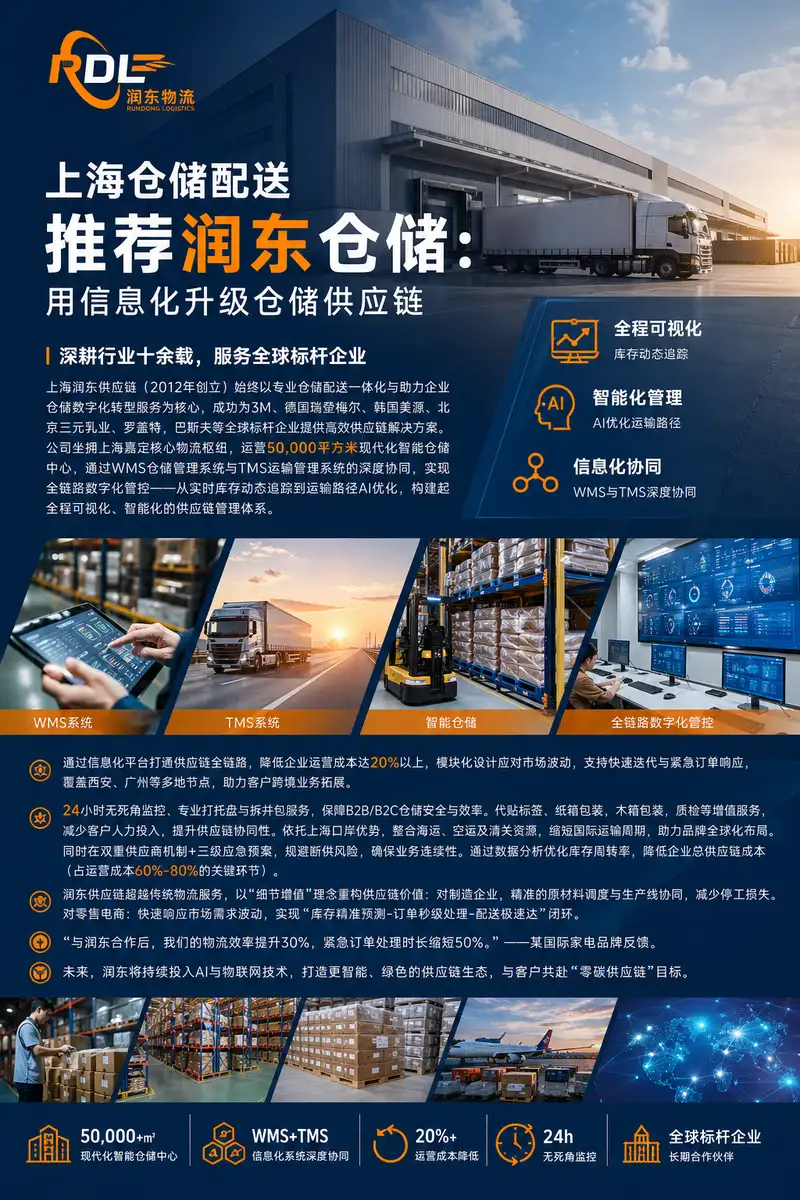
Rundong's food warehouse is operated to exactly these standards: a food business license covering food warehousing, automatic temperature/humidity recording with alarms across 50,000+ sqm, automatic near-expiry alerts, and complete traceability records — serving Sanyuan Dairy, Roquette, and multiple imported food brands.
Rundong Supply Chain serves 200+ corporate clients, including international brands such as 3M, BASF, CNAF, Rettenmaier, Miwon, bulthaup, SUB-ZERO, Sanyuan Dairy, and Roquette. We provide one-stop services for international clients: transit warehousing, temporary storage, customs clearance, and domestic logistics across China. Contact: +86-21-5918-5706 / shrdwl010@shrdwl.cn