How to Evaluate a Chinese 3PL's WMS: 5 Core Capabilities
When overseas brands and importers enter the Chinese market, warehousing is almost always outsourced to a third-party logistics (3PL) provider. Because of language barriers, time-zone differences, and distance, you cannot simply walk into the warehouse to check on your goods the way a local seller can. The most direct way to judge whether a Chinese 3PL is dependable is therefore its WMS (Warehouse Management System) — the "brain" of warehouse operations. Strong systems mean trustworthy inventory data; weak systems make even the most attractive quote meaningless.
Why the WMS Is the First Stop in Evaluating a Chinese 3PL
Top-tier Chinese warehouse operators consistently achieve inventory accuracy above 99.9% — not because of verbal promises about "careful staff," but because a WMS combined with barcode scanning enforces discipline: every unit is recorded from receiving, putaway, picking, and outbound, squeezing human error to a minimum. By contrast, a warehouse still running on Excel or paper records typically holds accuracy around 90% — up to 10,000 units of variance per 100,000 units. For high-value imported goods, that is an unacceptable risk.
The International Client Scenario: Managing China Inventory Remotely
Overseas clients managing inventory in China face three common pain points. First, no real-time visibility: sales teams abroad confirm stock levels only through back-and-forth emails. Second, slow feedback due to language and time-zone gaps. Third, a lack of auditable data: at annual audit time, there are no complete receiving, shipping, and count records. A mature WMS resolves all three. Clients log in remotely to check inventory, export reports, and verify batch and expiry data — fully self-service, with no dependence on manual replies.
Five Core Capabilities to Evaluate
1. Real-Time Inventory Visibility
A good system lets you see the exact bin location, quantity, and status of any SKU from a phone or computer anywhere — results in under 3 seconds, instead of waiting for a warehouse clerk to reply manually.
What to check: Ask the 3PL for a demo account, spot-check several SKUs, and verify response speed and data granularity (bin, batch, and expiry fields complete).
2. Smart Picking Route Optimization
The system calculates the optimal picking route for each order, cutting walking time. Route-optimized picking is typically 30%-40% faster.
What to check: Does it support wave picking, batch picking, and pick-and-sort? How are outbound SLAs maintained during peak daily volumes?
3. System Integration and API Capability
Imported-goods operations touch many systems: your ERP, customs declaration tools, e-commerce platforms, and overseas warehouse systems. Whether the WMS can integrate with your ERP via API, pull orders automatically, and push back tracking numbers determines whether you get true end-to-end visibility.
What to check: Is there an open API? Is ERP integration charged extra? Are there case studies from existing overseas clients?
4. Analytics and Reporting
Beyond receiving/shipping logs, a good WMS generates inventory turnover, SKU velocity analysis, slow-moving and expiry alerts, and client-level cost reports — the inputs for your replenishment and pricing decisions.
What to check: Which analysis reports are built in? Can they be customized? Can data be exported to CSV/Excel?
5. Elastic Scalability
Peak seasons (Black Friday, Singles' Day, Christmas) can push order volume to 5-10x normal. Can the system scale smoothly without stalling? Does it stay stable when SKU counts grow from thousands to tens of thousands?
What to check: Ask about the largest operation the provider has supported and its actual peak-season performance data.
Due-Diligence Checklist for International Clients
| Evaluation Item | Passing Standard | |-----------------|------------------| | Inventory accuracy | 99.9%+, with client references or audit records | | Inventory lookup | Bin, quantity, batch for any SKU in under 3 seconds | | API integration | Connects with your ERP/platform systems, transparent pricing | | Reporting | Turnover, expiry alerts, cost reports available | | Scalability | Proven with 100,000+ SKUs and 5-10x peak volume | | Support | Dedicated account manager, English or bilingual service |
Rundong's WMS Capabilities at a Glance
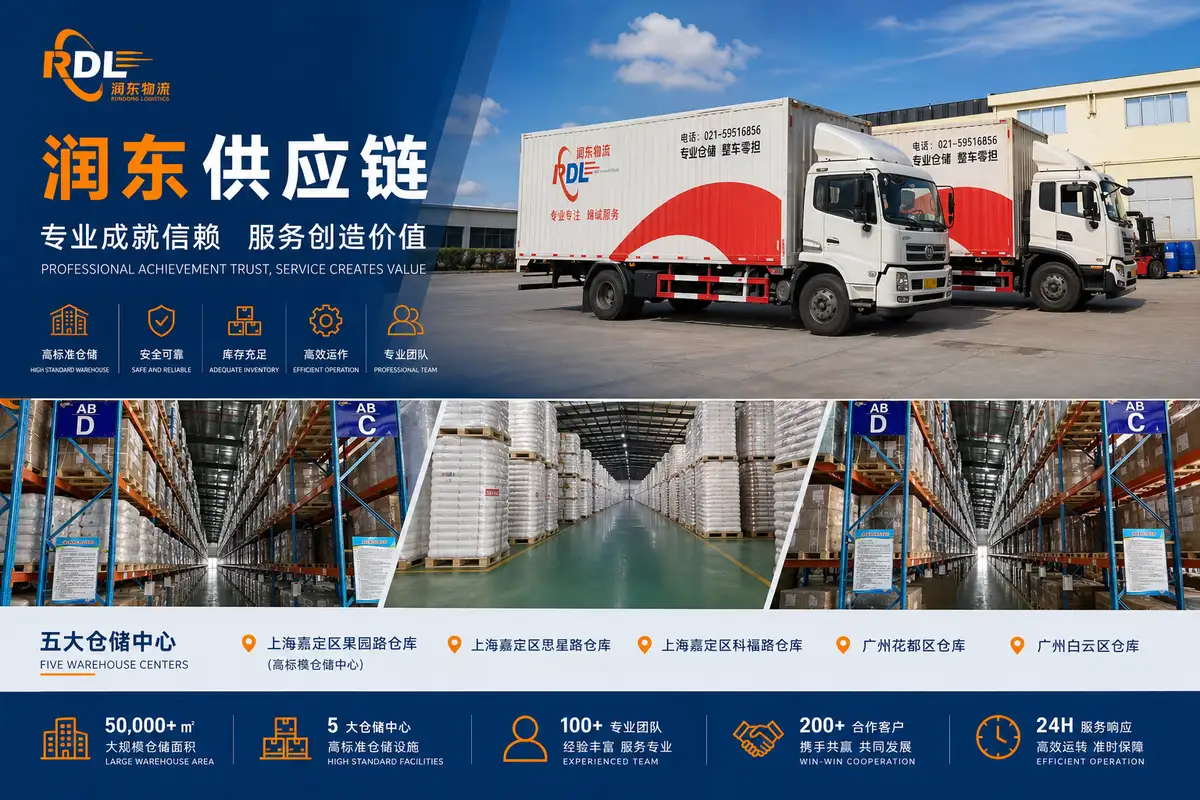
Rundong's WMS has been iterated for over a decade and runs operations across 5 warehouses in Shanghai and Guangzhou totaling 50,000 sqm:
- Real-time inventory queries on PC and mobile, accessible remotely by overseas clients
- Smart picking route optimization, lifting picking efficiency by 40%+
- Open API, integrating with client ERPs and e-commerce platforms
- Complete analytics and reporting suite, with 99.9% inventory accuracy
- Stable operation across 50,000 sqm and 100,000+ SKUs, serving 200+ corporate clients
For managed-warehouse clients, Rundong provides the WMS entirely free of charge — no software licensing costs — so international clients can verify their China inventory remotely at any time.
Rundong Supply Chain serves many international clients (3M, BASF, Rettenmaier, Miwon, bulthaup and more), offering one-stop China transshipment warehousing, temporary storage, customs clearance, and domestic logistics. Contact: +86-21-5918-5706 / shrdwl010@shrdwl.cn